
The studiolo of Piero di Cosimo dei Medici: for a new study and a digital reconstruction
Images and video content are subject to copyrighth ®
The lost studiolo: a new study
Dr.ssa Mariapaola Dominici
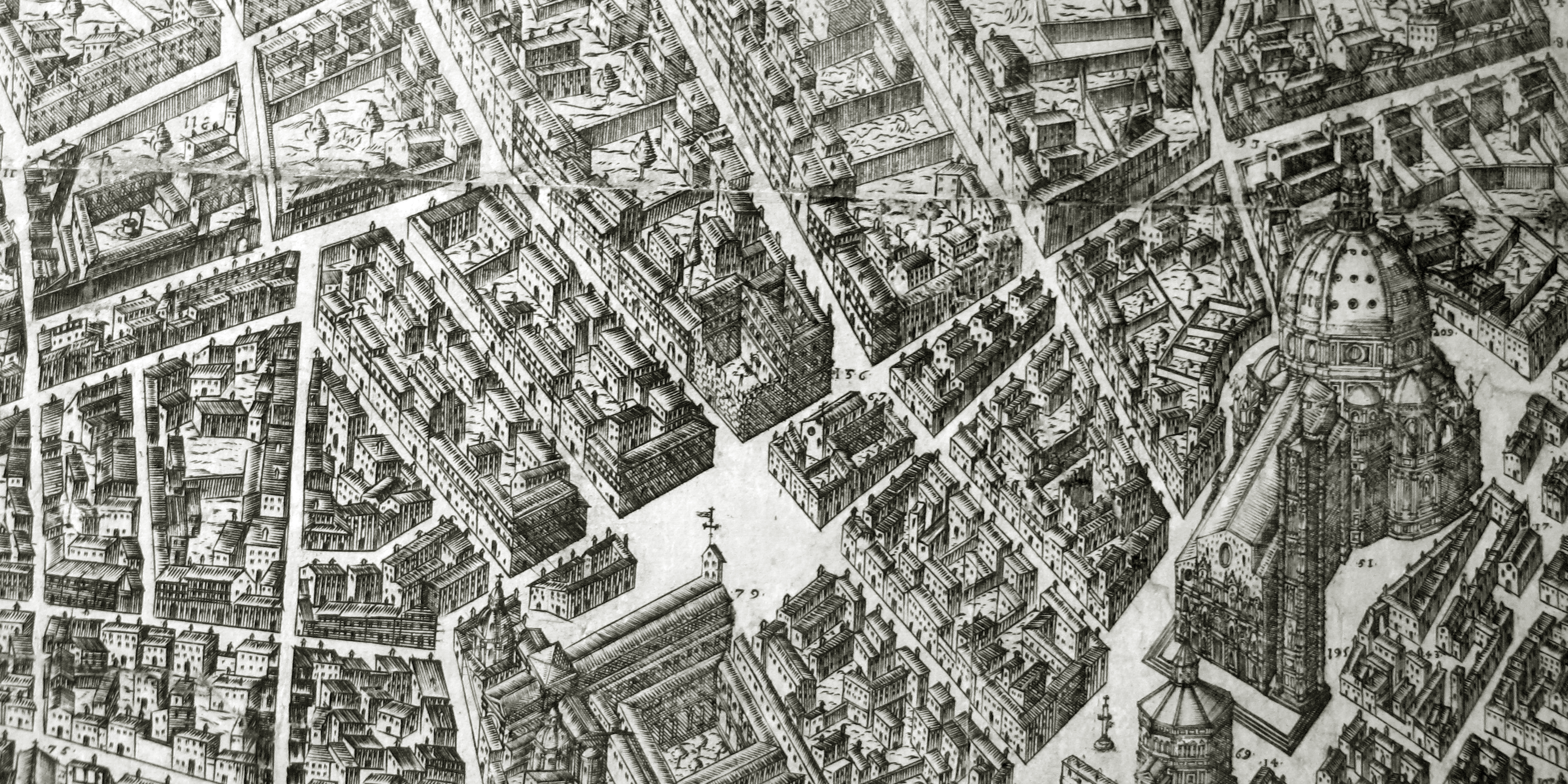
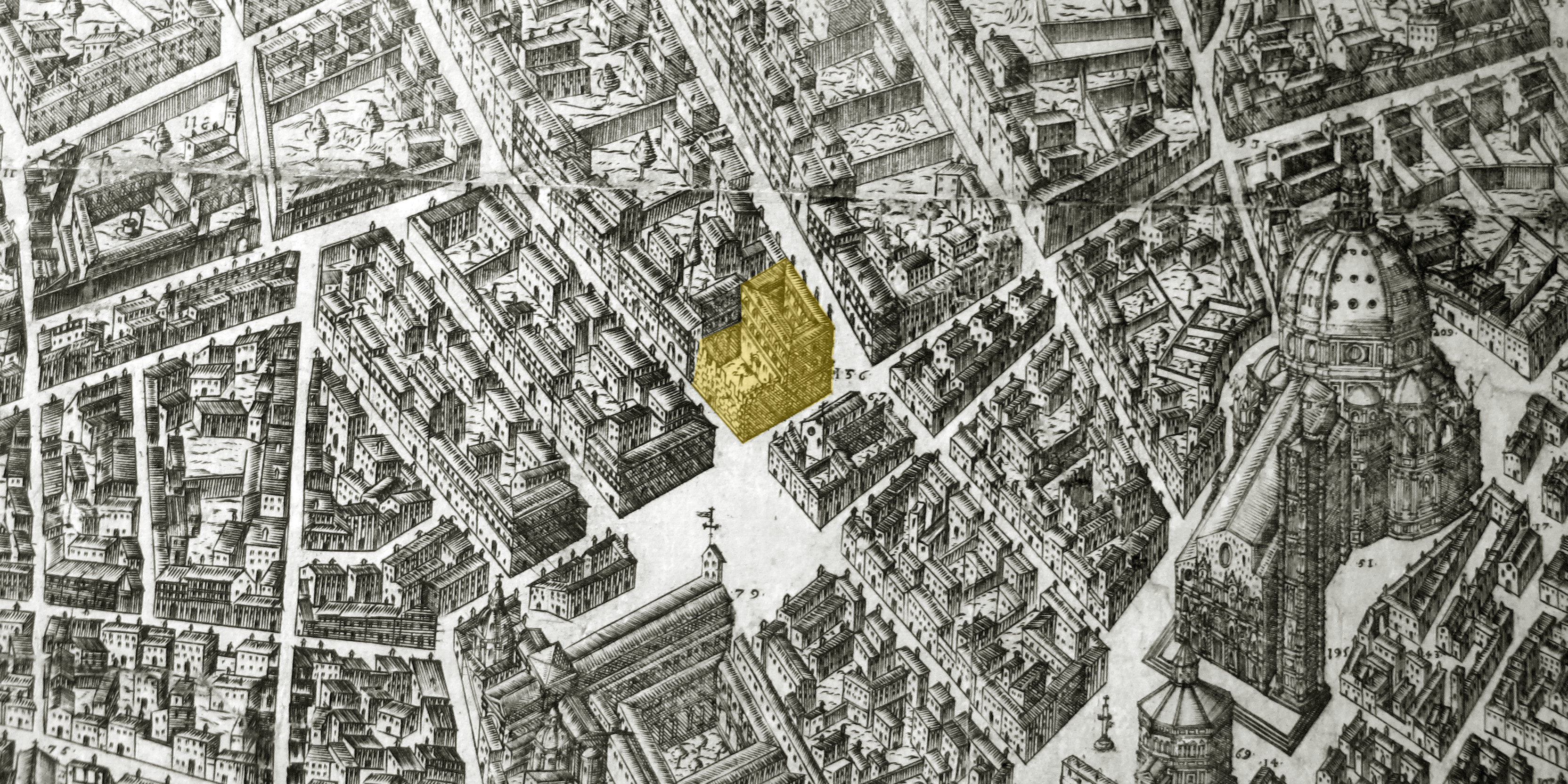
The location: Palazzo Medici in via Larga, Firenze
The Medici palace, built between 1444 and 1462 by Michelozzo, favourite architect and friend of Cosimo the Elder, has always been considered to be the first Renaissance palace, a model for later buildings inside and outside Florence. Built along the ancient via Larga and including part of the old properties of the family, the previous building was almost in the shape of a cube, divided into specular sections. Business was held on the ground floor; the family lived upstairs on the piano nobile, while the second floor, which also included the kitchen, was where the servants lived. Following the tradition, the studiolo was located in the farthest north-eastern corner of the dwelling, in correspondence with the tenth mullioned window of the earliest palace. Unluckily, the legendary studiolo, the most famous and celebrated studiolo of the XV century, was lost because of the massive restoration of the palace according to the will of the new owner, the Marquis Riccardi, who had acquired the property in 1659. The city government obliged the Riccardis to respect the original façade but nothing could avoid destruction of the interiors. The chapel of the Holy Trinity itself, usually known as the Magi chapel, the only remaining part of the ancient palace, adjacent to the studiolo and idealistically related to it, was jeopardized and it was the intervention of the Grand Duchess Maria Vittoria della Rovere which avoided the loss of it even if some changes modified its original architecture.
.
The roundels of Luca della Robbia at V&A
The only remaining objects of art which decorated the studiolo are the twelve roundels of the months by Luca della Robbia, today property of the V&A Museum in London, there exposed in a likely arrangement that is attached to a vault. The twelve roundels in precious enamelled terracotta are all at once a solar calendar and the sky above earth. The predominant colour is blue, though in different shades, and delicate, elegant figurines are busy with agricultural works related to each one of the months represented in the roundel. Each scene is painted in blue and white with quick, light touches of colour on a light blue background, and that is the only painted work by Luca della Robbia. The hours of daylight, specified with Roman numbers, and the hours of darkness are shown in the pale blue and the navy blue ring which surrounds each scene; lunar phases are visible at the bottom of each roundel while the sun is represented as a human face on the top left side and behind it the corresponding zodiac sign. Each roundel is surrounded by remains of serpentine green and burgundy red, colours we see in many Medicean complexes.
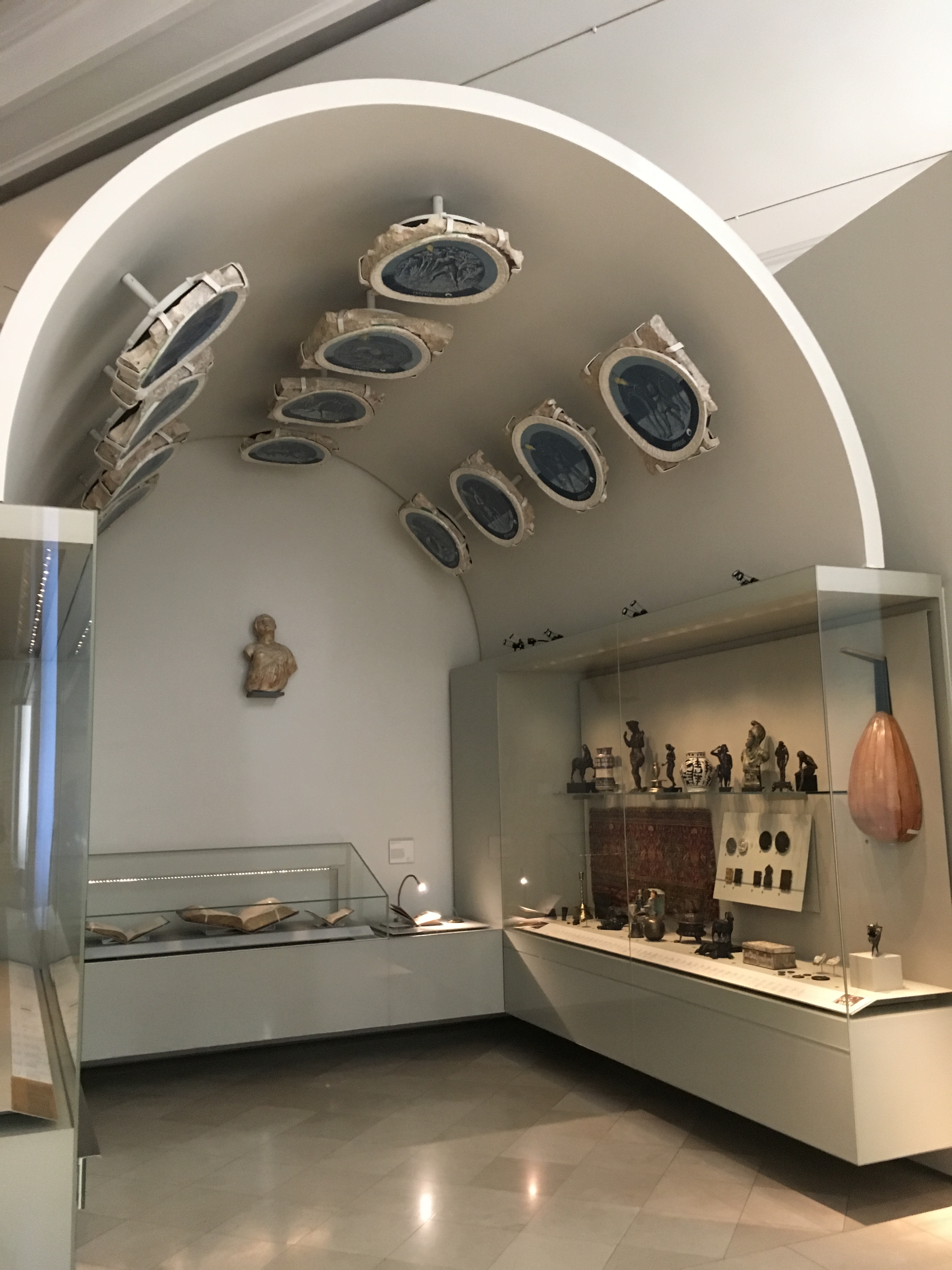
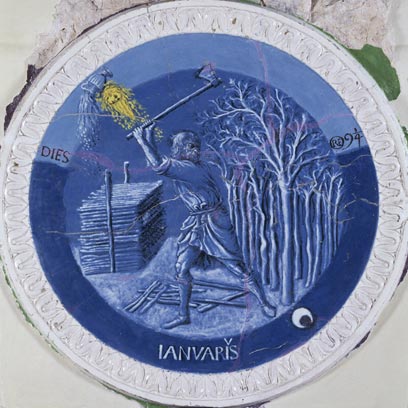
The roundels of Luca della Robbia in Victoria and Albert Museum.
The owner: Piero di Cosimo Medici
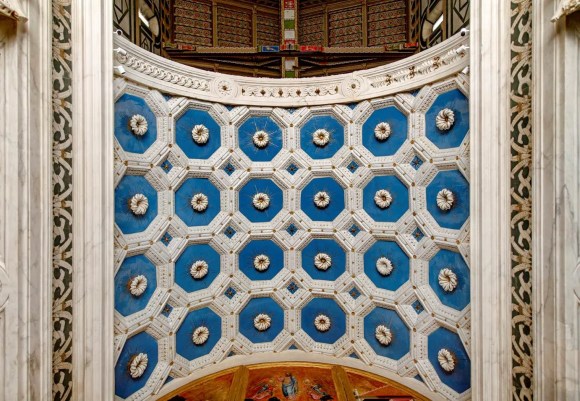
The great creator of the studiolo is Piero di Cosimo Medici, eldest son of Cosimo the Elder and Contessina de’ Bardi, father of the more famous Lorenzo the Magnificent. Piero increased the family collections, personally supervised the frescoes of the adjacent chapel and he commissioned the precious decoration of the studiolo. Differently from the austere sobriety of his father, Piero loved jewels, exotic objects, preciousness, richness in fabrics and in details. His education was rooted in the cultured ambience of the Estensi Court, north east of Italy, in the valley of the Po river. Pupil of the scholar Guarino Veronese, he breathed the sophisticated and cultured ambience of the Council of Ferrara, eventually transferred to Florence. As a matter of fact, the arrival of those scholars from Ferrara and from Constantinople along with Piero’s elegant tastes would transform the severe austerity of the city in a sophisticated ambience where precious objects of art and craftsmanship were created. Piero loved Flemish art, up to that time practically unknown in Florence , and its abundance in exquisite details; he commissioned beautiful, small-sized pieces, and he seemed to be doomed to decorate magnificently the severe architectures wanted by his father, among them the studiolo of the piano nobile, the sumptuous container of the unique collections of the family. Wherever Piero was patron, he would have his personal symbol shown, an unequivocal sign of his presence: the diamond ring with the feathers, well visible, for example, on the top of the precious tabernacolo del Crocifisso in the church of San Miniato al Monte in Florence, whose chronology, according to Pope Hennessy, precedes of a few years the decoration of the studiolo. The architect of the shrine is Michelozzo, the same architect of the family palace, the superb decoration is the work of Luca della Robbia, one of Piero’s favourite artists. The shimmering enamelled terracottas of Luca must have flattered the eyes and the soul of Piero, and they would eventually be transferred onto the vault of the studiolo.
.
Documentary sources: descriptions, images, other studioli
Traditionally, the studiolo is a secluded area, apart and distant from the matters of daily life, the most intimate place in a dwelling where the owner and a very few others have access. The cosy, intimate den where words evoke the dear ones like Petrarca’s beloved Laura, the place where Machiavelli holds a dialogue with the ancient fathers; similarly, in his studiolo Piero would set himself apart from worries and troubles of his daily life and find relief from physical paint caused by gout, responsible for his nickname as he is usually known as Piero the Gouty. So that, in the Medici Palace too, the studiolo was located at the end of the sequence of rooms typical of the Renaissance palace, where the last two ones, Piero’s rooms, preceded his most secluded space to which he had his own private access from his apartments as we read in the words of Filarete who dedicates the second edition of his Trattato di Architettura to Piero, one of the very few sources for this study together with two letters and a long poem, essential pieces of information in addition to different archive evidences including inventories of the family, which unveil us the amazement and the wonder arisen by the studiolo and the importance of this unique room for Piero himself.
The last description of the studiolo is in Vasari’s life of Luca Della Robbia, which follows of about a century. Feasibly, he saw it still intact in its decorations, but for sure empty. The palace was pillaged in 1494; also in the XVI century collections were by then exposed in galleries instead and the fragility of wood had to be another reason for loss of that tradition. Nevertheless, the studioli still left in existence, Urbino, Gubbio, now at the MET in New York, the one at Hampton Court too, nowadays essentially deprived of their precious contents, they all still preserve the existence of a source of natural light, that is a window.
The studiolo structure: the plan, the walls, the window
Besides the sources, the only ancient planimetry in existence made when the studiolo was still at its original location, is the one by Gerardo Silvani. Probably made for the future change of owners, it dates back to 1650 and it is property of the State Archive of Florence. The drawing is in black ink and in pink watercolour; there is no scale, and it lacks reference points. A few notes inform that by that time the palace was divided into different-sized apartments inhabited by various people somehow related to the Medici; the ground floor was being used as a working area for the nearby complex of the Chapel of the Princes, while the Grand Duke branch of the family by then lived at the Pitti palace.

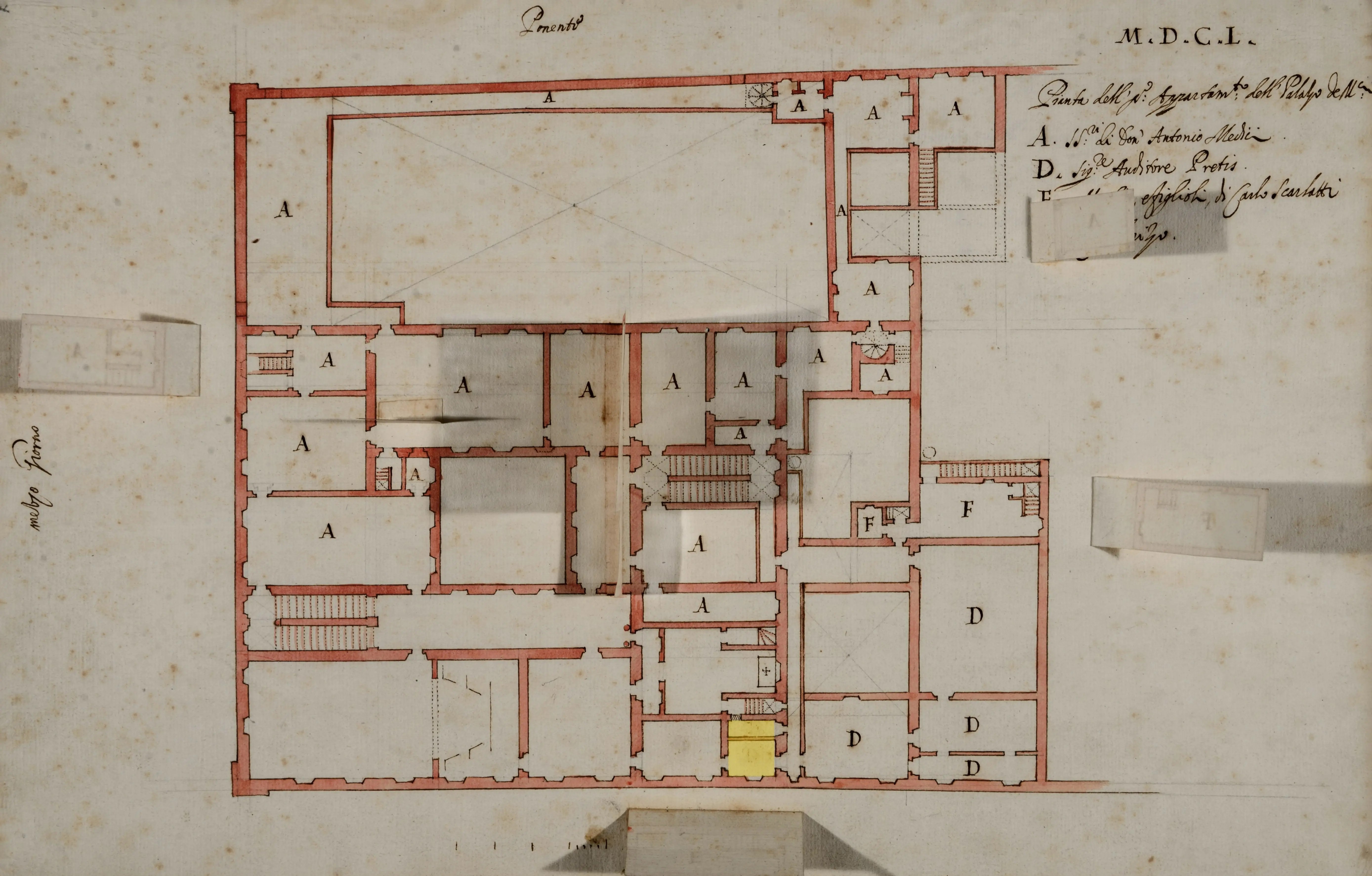
Observing Gherardi’s plan, we have noticed that the surface occupied by the studiolo is divided in two sections by a thin, pink line. That does not look at all like a load-bearing wall, it seems to be a room divider instead, a fake wall, built we do not know when, most probably to split the whole volume into two sections for whatever practical reason. Fundamental to our research was the possibility of having access to the digital relief of the palace in order to compare it with Gherardi’s plan, so what had been assumed became evidence: that thin room divider was not a load-bearing wall. Truly, in 1911 the German art historian Hans Willich draws a plan of the palace and locates the studiolo ignoring that thin room divider. As a matter of fact, this is our hypothesis too. We state the absolute conviction that Michelozzo, who had built la casa di Cosimo, would not exclude light from the precious, highly symbolic chamber, adjacent to the chapel in a mute, ideal dialogue and, last but not least, where else could he possibly set the vault if not on the same axis of the elegant Renaissance window? Nevertheless, the idea of Willing unaccountably disappears in later studies which seem to rely instead on the splitting of the area in the two sections as seen in Gherardo Silvani’s plan. So that, in the drawings of Bulst dating back to 1970, and the others studies which would follow, like de Juliis (2025), it seems that scholars have adopted this idea, that is the long side of the studiolo parallel to the ancient via Larga, thus excluding the natural source of light, which explains why in later studies the window is practically ignored, completely or partially plugged.
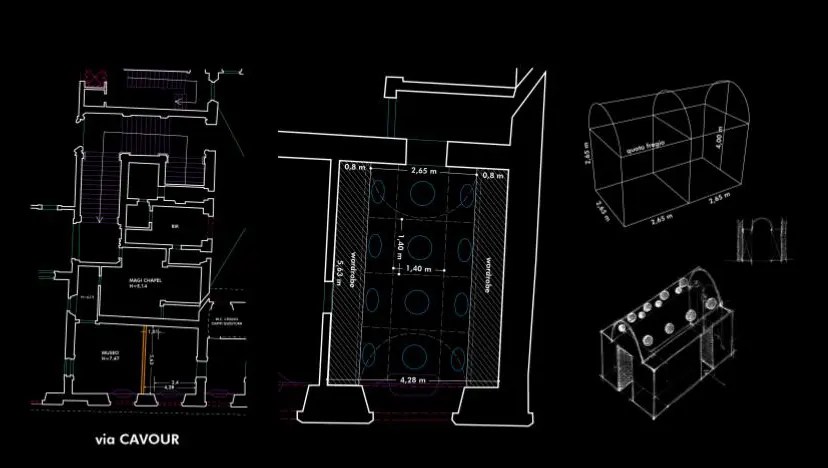
The next step was the definition of the volume of the studiolo with the support of architect Lorenzo del Mastio. The only undoubted measure we have is the distance of the left jam of the window to the wall which used to be the north side of the palace, so that the distance between the right side of the window jam and the wall that divided the studiolo from Piero’s room had to be the same. Lorenzo del Mastio drew the yellow line which defines the width and the length of the studiolo. Then it would be the definition of the vault, where the twelve roundels, each one of a diameter of about 60 centimetres, would not be sufficient to cover the whole surface of it. The remains in green and burgundy we see around the roundels suggest that they had to be inserted in other geometrical figures, twelve geometrical figures big enough to cover the whole surface of the vault which had to be on the same axis as the top line of the arch of the window, set on the sections of the walls where the cupboards were built in.
Lorenzo del Matio was finally able to build the volume: a chamber with a length of 5.63 metres and a width of m. 4,25, the width reduced of 80 centimetres on each side, that is the depth of each built in the wall cupboard, featuring different interior depths, depending on what would be inside, including drawers, desks and seats, so that the walking surface had to be 2.65 metres. The size of the vault features a diameter of 2.65 metres and a perimetral line of 4,16 metres. In order to completely cover the whole surface of the vault, the roundels had to be inserted in twelve squares, each one with a side of 1,40 meter.
Once the volume had been recreated, then it would be completed with the decorations and the elements gathered together thanks to a vast, patient work of research and selection of images, models for similarities and confrontation which would philologically, historically and convincingly bring back to a new life the lost, precious chamber. Numerous images of vestries and of other studioli, among them the studiolo of Urbino, generally agreed as heritage of the studiolo of the Medici palace, and hundreds of images of works by Luca della Robbia and his workshop and the later production of his nephew Andrea too. Among them all, the closest model is undoubtedly the precious tabernacolo del Crocifisso, in the church of San Miniato al Monte in Florence. Finally, let’s now imagine the serene cove where Piero finds a shelter from the rough waters of life, enjoying being afar from pain, anxiety and fears as narrated in the verses of De Rerum Natura of Tito Caro Lucrezio. Immersed in beauty, wonder and peace, Piero can foretaste the perfect beauty awaiting him at the end of his path on earth, moments of life on earth and in nature as described in the vault, leading to the eternal and perfect beauty, everlasting love and joy unveiled in the chapel, the sacred adjacent shrine, ab æterno et in æternum.
The lost studiolo: a digital reconstruction
Dr.ssa Elena Bastianini
Imagine lo studiolo
Professor Lorenzo Gnocchi, my old teacher at the University of Florence, introduced me to Mariapaola Dominici, once she had finished her philological and historical research as he knew that I deal with historical reconstructions as an art historian and 3D artist. At that moment the structure of the studiolo had been reconstructed but without any decoration. My task immediately struck me as extremely interesting: a photorealistic reconstruction of the most famous studiolo of the XV century, a place that had so fascinated and inspired scholars and artists of the time, but which unfortunately has not reached us. The exchange of visual materials with Mariapaola was very fruitful, particularly paintings of the XV century showing studioli, among them, for example, the ones of Saint Jerome and of Saint Augustine, respectively frescoed by Domenico Ghirlandaio and by Sandro Botticelli in the church of Ognissanti in Florence. Another useful source was the existence of surviving studioli, albeit often damaged and/or updated at later times, among them the studiolo of Urbino, property of Federico da Montefeltro, and the one of Isabella d’Este. Many later studioli were inspired by Piero’s famous one, as if it were the lost matrix, which could now be reconstructed through the echoes it had left. An immersion in the art of the time made me look at those images and studioli from a new perspective, trying to decode the relationships and proportions that constituted their essence. My task was complex: I had to imagine the studiolo in its rich and harmonic XV century decoration that consisted of three main parts, the vault, the floor and the wooden cupboards, the so called armari.
Terra-cotta vault of Luca della Robbia
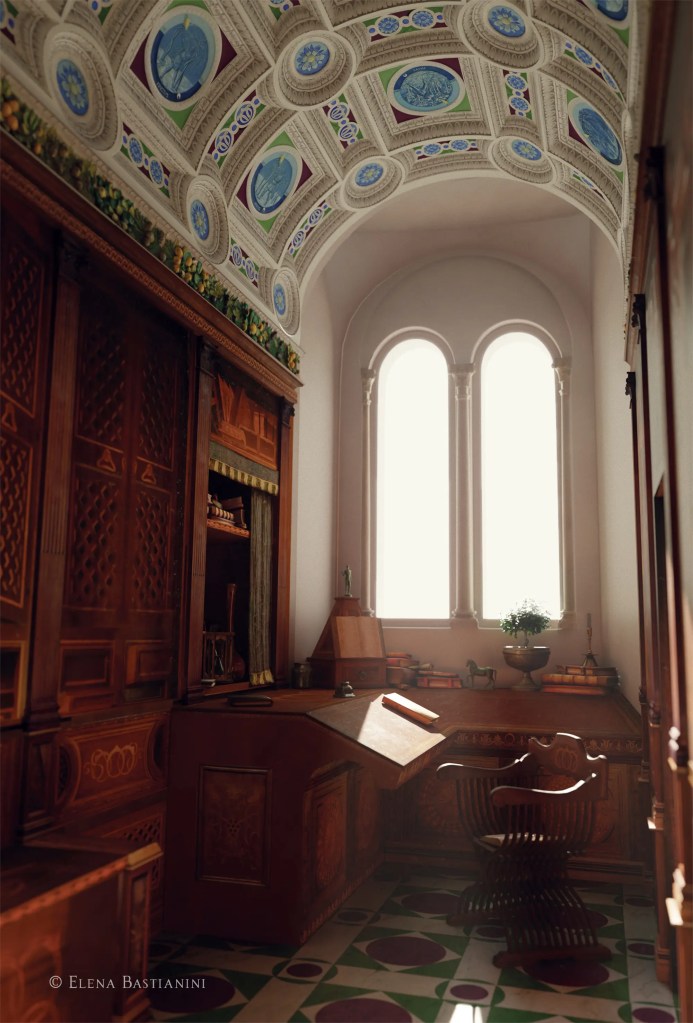
I started with the barrel vault because it’s the only part of the studiolo of which we have remains: the marvellous roundels of Luca della Robbia. They were inserted in the large surface, as you can see in the arrangement at the V&A in London, and the bare sections, as we see them nowadays, which surrounded the roundels, had to be filled with decorative elements. We have opted to inscribe the circles in a red and green square because fragments of those same colors remained around twelve months. Looking at coeval ceilings and vaults, particularly at those of Luca della Robbia and his workshop, we have noticed that each section of the surface is wonderfully decorated and that each central element is abundantly surrounded by precious, multiple frames, whose predominant pattern is floral and herbal. I have created the digital reconstruction of the vault with similar enamelled blooming flowers and blossoms arranged in the round frames that had to be around each of the twelve roundels. A rich garland with fruits and leaves runs along the base of the vault and Mariapaola suggested inserting the eagle as another symbol of Piero. This way we felt we were respecting the theme of men busy working land, as shown in the roundels of the months, labour that with the essential support of light produces generous fruits and flowers.
The pavimento all’antica
The second step was the floor. Since Vasari described it as similar to the vault, we have composed the pavement as a projection of the ceiling, that is round shapes inserted in squared sections, each piece separated from the other using straight elements. As far as the colours are concerned, we have used the ones memories of the ancient marble pavements so popular in the mid XV century, as seen in many coeval paintings and in other Medicean commissions, including the adjacent Magi chapel.
The inlaid armari
Finally, the third step was the assembly of the wooden cupboards. XV wood-inlay is particularly fascinating because it blends technical expertise with sophisticated perspective. A charming example is the Sacristy of the Masses in the nearby cathedral of Santa Maria del Fiore. It is believed that in the studiolo there had to be a desk, some kinds of seats and at least a chest of drawers, most likely near the window, as we see in many coeval paintings. We have imagined foldable seats and benches like the ones still in existence in Federico da Montefeltro’s studiolo and in the adjacent Magi chapel. We have decorated the wooden panels with prospective inlays suggesting the contents of the cupboards; last but not least, we have marked the decoration with a seal, that is the diamond ring with feathers, Piero’s coat of arms, visible on all the works of art he commissioned. Also, we have imagined as part of those precious decorations, some ornaments and a few other pieces evoking Piero’s collections, then we have decided to complete the whole with that thin curtain, as seen in Van Eyck’s San Gerolamo, a painting that was probably part of the collections of Piero.
Conclusions
In order to build the studiolo in 3D, we have used Blender, an open artsource software. Our goal was to recreate a realistic space based on art at mid XV century; for the final render we have decided to set up the scene with the brightness of a sunny day, as suggested by the solar calendar of the vault. Besides all that, thanks to ultimate modern technology, onother possible application could be a virtual reality tour to experience this precious studiolo, an emotional time travel to the Renaissance. Nevertheless, just virtuality is not satisfactory enough and that’s why at the present moment we are constructing a wood and plaster scale model of the studiolo. Actually, possibilities are endless and there could be more and more options to make the celebrated, lost studiolo come back to life.
.
Sources
Gian Galeazzo Sforza, Letter of 17th April 1459;
Niccolò Carissimi di Parma, Letter of 17th April 1459;
Terze rime in lode di Cosimo de’ Medici e de’ figliuoli e dell’onoranza fatta l’anno 1459 al figliuolo del duca di Milano e al Papa nella loro venuta a Firenze, 1459.
A. Filarete, , Treatise on architecture, 1460 ca:
Bibliography
BULST W.A., Die Urspringliche innere Aufteilung des Palazzo Medici in Florenz, «Mitteilungen des Kusthistorischen Institutes in Florenz», XIV, 1970, 4, pp.369-392;
G. DE JULIIS, Giovan Battista Foggini e lo “scrittoio” di Piero il Gottoso: ipotesi per un progetto di recupero in Giovan Battista Foggini : architetto e scultore granducale : Florence, Palazzo Medici Riccardi, 2025] / a cura di Riccardo Spinelli;
POPE-HENNESSY J., Luca della Robbia, Oxford, Phaidon, 1980;
VASARI G., Le vite de’ più eccellenti architetti, pittori, et scultori italiani, da Cimabue,
insino a’ tempi nostri, Firenze, L. Torrentino, 1550
WILLICH H. – ZUCKER P.,Die Baukunst der Renaissance in Italien bis zum Tode
Michelangelos, Berlino, Akademische Ferlagsgesellschaft Athenaion M.B.H, 1914;
.
 Elena Bastianini